Header/Navigation Bar/Social Media Icons

Thursday, September 12, 2019

Module A

Hello Parents,
We are off to a great start! The third graders in our class are nothing short of amazing. I can't believe how responsible, respectful and safe they are. Keep up the great work! I just wanted to give a few reminders for this month. I will be updating the blog according to the modules we cover in class. It will usually be monthly depending on the module. I will make sure to let you know of any important events that come up. So far this is what we have coming up and new info will be added when I get it. Thanks!

Upcoming Events
Thursday, Sept. 12- Book Orders Due
Friday, Oct. 11-Picture Retakes
Monday, Oct. 28- Fundraiser Raffle Money Due


This Module launches the tools and habits of mind important in a 21st century English language arts classroom, with an emphasis on routines and procedures that will be used throughout the year to study reading, writing, language, and reading foundational skills. In this Habits and Routines module, student’s co-construct anchor charts to describe the behaviors and expectations related to important habits and routines based off of district MTSS-B / CHAMPS guidelines. Structures, routines, attitudes and habits will continue to be introduced throughout. Students will use the foundational strategy of VISUALIZATION to promote other comprehension strategies, moving into QUESTIONING. This strategy focuses on using all of the five senses to help comprehend a text. Students learn to select “good fit books”, demonstrate reading preferences, and use a reading log to monitor reading stamina. Students demonstrate understanding of texts read by asking and answering questions during collaborative discussions. Students engage in these processes with the goal of deepening understanding of text and of themselves. Students will be introduced to narrative writing in Writer’s Workshop; focusing on the process of generating ideas, storyboarding, and drafting.

I CAN STATEMENTS

  • I can demonstrate expected classroom behaviors. (Refer to CHAMPS anchor charts) 
  • I can demonstrate expected school life skills. (Refer to life skill posters)

READING
  • I can use my readers’ notebook to track my thinking and collaborate with others. (RL.3.10, SL.3.1)
  • I can identify character’s traits by a character’s actions, dialogue and feelings. (RL.3.3)
  • I can pick a “good fit” text to build my stamina and set goals. (RL.3.10, RI.3.10)
  • I can ask and answer questions while reading to check for understanding. (RL.3.1, RI.3.1)
  • I can explain how illustrations add to the story elements. (RL.3.7)
  • I can turn and talk with any peer. (SL.3.1)
  • I can speak in complete sentences to give details and check for understanding while in conversation. (SL.3.6)

WORD STUDY
  • I can use my word study journal to become a better speller. (RF.3.3) (Units 1-3) 
  • I can spell compound words correctly. (L.3.6)
  • I can add the –ing suffix to base words correctly. (L.3.6)

MATH

Number and Operations in Base 10
  • Use efficient math strategies to build fluency with basic addition and subtraction facts (3.NBT.2)
  • Use strategies based on place value, properties of operations, or the relationship between addition and subtraction to fluently add and subtract within 100 (3.NBT .2)
    Operations and Algebraic Thinking
  • Write equations to represent one-step story problems (3.OA.8)
  • Determine whether two expressions are equal (3.OA.1)
  • Use efficient math strategies to build fluency with basic addition and subtraction facts (3.OA.8)
  • Identifies patterns among basic addition and subtraction facts - found in Unit 1 Module 1 session 4 &5 and Unit 1 Module 2 Session 1 & 2 (3.OA.9)
    Measurement and Data
• Constructs and reads scaled picture graphs and bar graphs, and solves problems using the information in a graph – found in Unit 1 Module 1 Session 1 & 2 (3.MD.3)
Trimester 1 Proficiency Scale (3-Meeting Expectations)
3.OA.1
Understands what it means to multiply; writes story problems or describe situations to match multiplication equations
page29image16078864
3.OA.3
Solves multiplication story problems within 100
page29image16079648
3.OA.4
Solves for the unknown in a multiplication equation
3.OA.7
Uses strategies to solve multiplication facts
page29image16081216
3.OA.8
Uses addition, subtraction, and multiplication to solve story problems that require more than one step
3.OA.9
Identifies patterns among basic addition and subtraction facts
3.NBT.2
Adds and subtracts 2-digit numbers
3.MD.3
Constructs and reads scaled picture graphs and bar graphs, and solves problems using the information in a graph

WRITING AND GRAMMAR
  • I can write personal narratives to entertain my audience. (W.3.3)
  • I can storyboard, draft and edit my personal narratives. (W.3.5)
  • I can use technology to publish my personal narratives and blog with classmates. (SL.3.4) 
  • I can identify nouns, pronouns, verbs, and their function. (L.3.1) 

Tuesday, May 7, 2019

Module I

Upcoming Events
May 9th- Color Run
May 22nd - TNT Field Trip (bus will leave around 12:20)
May 28th- Field Day (just for kids...they will be going during their specials)
May 30th- Last Day of School (Inflatables during specials)


In math, we are wrapping up our unit on geometry. Our last unit is on multiplication, division, fractions and solving two-step story problems.  We will be discussing the commutative, associative and distributive properties as well. In science, we will be starting a unit on life cycles and will have crayfish in the classroom.

Tuesday, April 2, 2019

Module H

Upcoming Events
April 1, 2, 3, 8 & 9th- State Testing
Friday, April 5th-Field Trip to Concordia Marimba Concert
Friday, April 12th- 6 p.m. Movie Night in the Gym
Friday, April 19th - No School(Monday the 22nd is now a makeup day so there will be school)
May 9th- Color Run
Wednesday, May 22nd - TNT Field Trip (bus will leave around 12:20)
In math, we are working on Multiplication and Division. Students are working on answering multi-step story problems, making arrays, solving fact families and knowing their multiplication and division facts. Please practice multiplication/division fact cards at home with your child. Thank you!

Wednesday, March 6, 2019

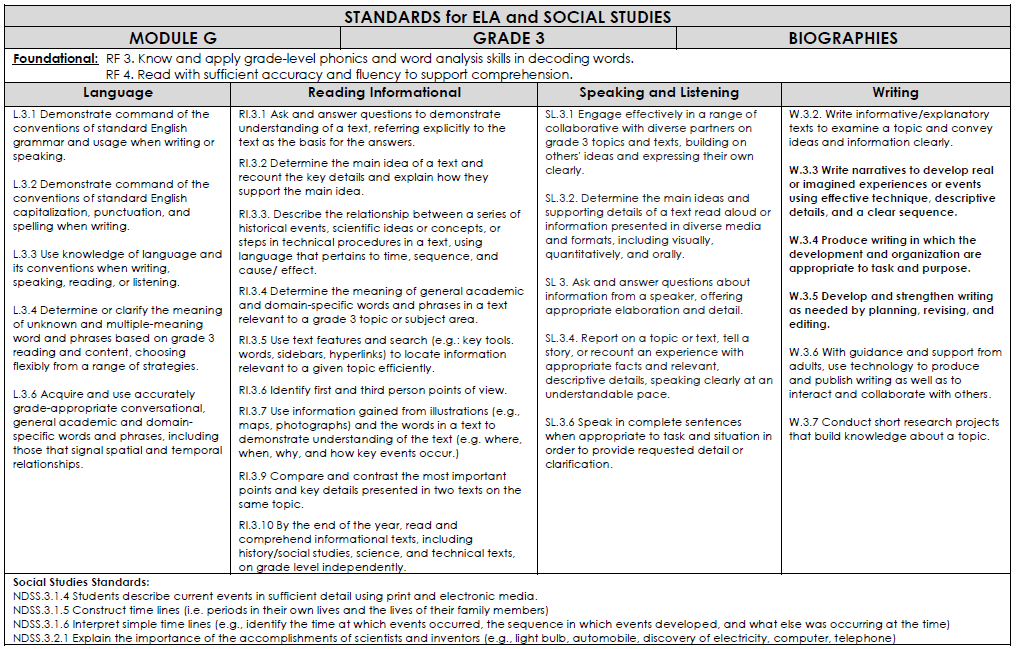
Module G

Upcoming Dates
Mar. 8-Music Concert 8:30a.m. in gym


Mar. 11-12-Parent/Teacher Conferences
Mar. 15-No School (Mar. 14th is now a make up day so we will have school)
Please sign up for conferences at the following link: http://www.ptcfast.com/schools/osgood


In math we are working on: 
-Units of measurement
-Some of the vocabulary we are using are volume, mass, length, liters, grams, kilograms, milliliters, centimeters, meters, numerator, denominator, equivalent, fractions, a.m., p.m., minutes, hour
-We are learning about elapsed time, fractions on a number line and shapes, volume, mass, length, and story problems. A few areas that we are focusing on is showing our work, box the answer and labeling units.


Thursday, February 28, 2019

Dreambox Challenge (February 18th- March 15th)


We have found that DreamBox usage is positively correlated with student achievement gains. To help ensure your child gets the most out of DreamBox, we have developed the following recommended usage guide:
In order for students to reach their weekly lesson goals, we recommend setting up multiple sessions of DreamBox throughout the week and having students complete at least one or two lessons every time they log in. Encourage students to develop the following habits:
  • Be okay with mistakes. As long as students complete lessons, DreamBox will be able to assess their comprehension and adapt.
  • Work independently. Helping a student through a lesson can progress them beyond their current abilities and lead to frustration.
  • Only use the virtual manipulatives. DreamBox lessons are designed for students to think through problems without the use of pencil and paper.
  • Use the help/hint button when needed.
  • Use headphones with the volume on.

Monday, February 4, 2019

Module F

Upcoming Events:
Feb. 11-15- Kindness Week Dress Up Days

Feb. 12-Book Orders are Due
Feb. 14-Valentine's Day Boxes Due (Please wait until Feb. 11th to start bringing them in)
Feb. 18-No School
Feb. 22-Game Day 1:15-2:15pm
Feb. 28-Literacy Night 5-7pm
Mar. 8-Music Concert 8:30am


Dr. Christina Hargiss is a professor at NDSU in the Natural Resources Management program.  One of her passions is teaching kids about the outdoors.  One of the courses she teaches is Environmental Education and Outreach.  Dr. Hargiss along with the 25 students in the class will be putting on an environmental day for all the second and third graders at Osgood.  During the NDSU class the students learn to work with elementary, middle and high school learners, college learners, the community and professionals.  At Osgood, NDSU students will work in groups to teach the second and third graders about environmental topics such as energy and mining by doing a cookie mining activity, about safe drinking water and pollutants, and different layers of the earth through “coring” cupcakes.  There will be 8 activities total and each class will be able to take part in 5 activities based on time availability.  These are fun ways for Osgood students to learn about the outdoors and real world concepts.  

Math
  • I can use an algorithm to subtract fluently with minuends to 1,000 (3.NBT.2)
  • I can use strategies based on place value, or the relationship between addition and subtraction to subtract fluently to 1,000. (3.NBT.2)
  • I can explore fractions (halves, thirds, fourths, sixths, eighths, and twelfths)
  • I can discuss and find equivalent fractions and equations for fractions and explore whole numbers as fractions.

Thursday, January 10, 2019

Module E

Hello Parents,
We are starting Bridges, a new curriculum in math this month. The units have great games that incorporate the skills from each lesson and it will align with number corner (calendar math that teaches mini lessons that tie together). In math, we are working on the following I can statements.
I can......

  • Solve two-step story problems using addition, subtraction, multiplication and division.
  • Write equations with a letter standing for the unknown quantity to represent two-step story problems.
  • Round whole numbers to the nearest ten or hundred.